Physical Address
304 North Cardinal St.
Dorchester Center, MA 02124
Physical Address
304 North Cardinal St.
Dorchester Center, MA 02124

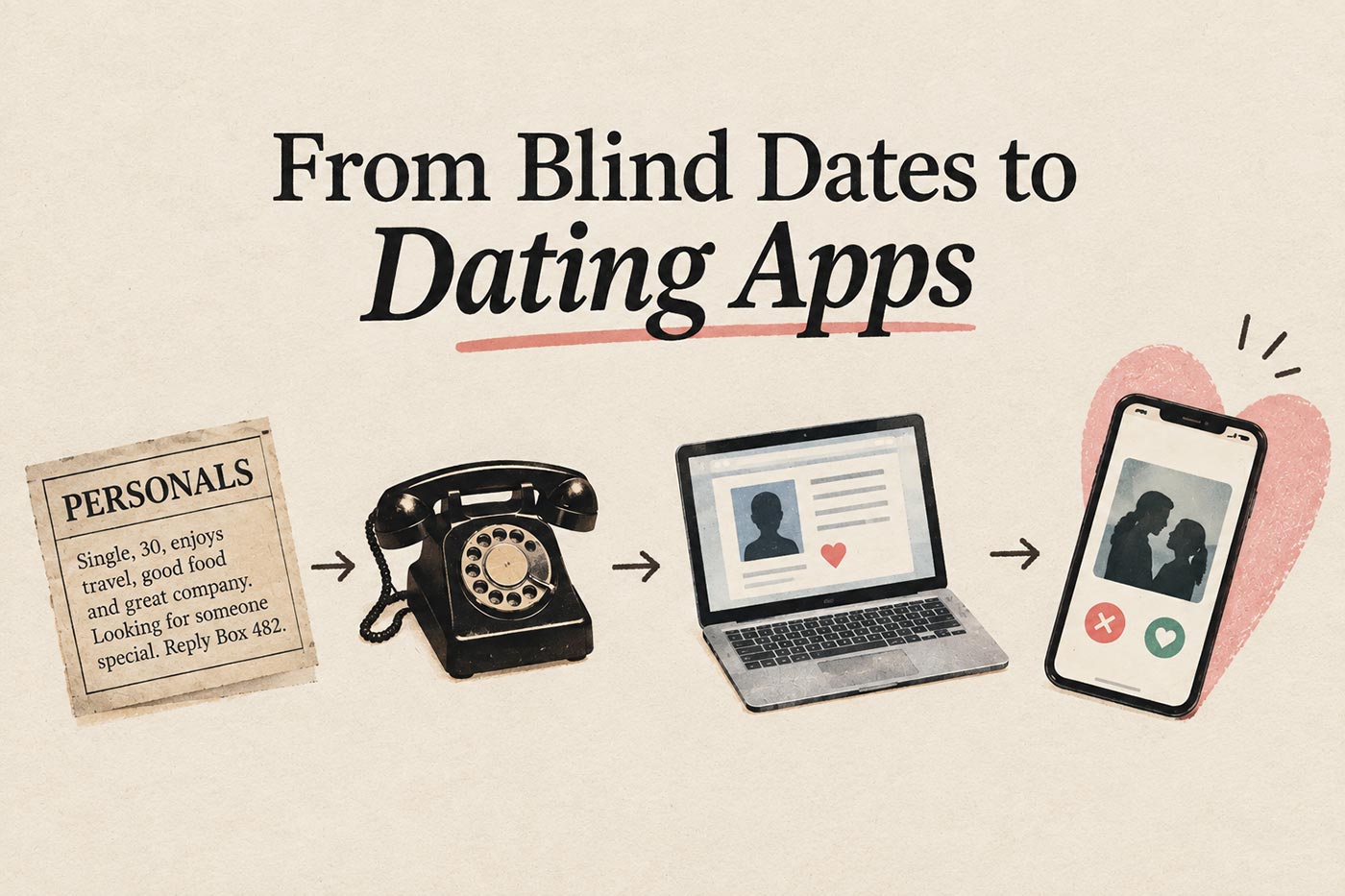
Dating has changed dramatically over the past century. What once depended on family introductions, social gatherings, chance encounters, or carefully arranged blind dates has evolved into a world of phone dating services, online personals, dating websites, virtual escorts and smartphone applications that can connect millions of people in seconds.
The technology is almost unrecognizable compared with what previous generations knew. Today, someone can meet a potential partner while sitting on a bus, waiting for coffee, or relaxing at home. A few photographs, a short biography, and a swipe can open the door to a conversation that might eventually lead to a relationship.
Yet beneath all these innovations, something fundamental has remained remarkably consistent. People still want to meet someone interesting, feel desired, discover whether attraction is mutual, and find out if a stranger could become something more.
The history of dating technology is therefore not simply a story about machines and communication. It is also a story about how society has adapted its oldest romantic instincts to new circumstances.
Long before dating apps existed, people relied on personal networks to meet potential partners. Friends, relatives, colleagues, and acquaintances frequently acted as intermediaries, introducing two people who might be compatible.
The blind date became one of the most recognizable expressions of this tradition. Two people agreed to meet without necessarily knowing much about each other beforehand. Sometimes a mutual friend organized the encounter. In other cases, social clubs, community groups, or family connections provided the opportunity.
Blind dates carried a particular kind of excitement because they involved genuine uncertainty. Participants might exchange a few details before meeting, but much of the experience depended on first impressions. Appearance, voice, manners, humor, and conversational chemistry all played important roles.
The arrangement also reflected the social conditions of its time. People often lived within smaller social circles, and their opportunities to meet potential partners were shaped by work, education, family expectations, and geography.
A blind date could expand those circles, introducing someone to a person they would probably never have encountered otherwise.
Of course, traditional dating had limitations. A person’s social network might be narrow, and introductions could be influenced by family expectations or assumptions about class, religion, and social background. Meeting new people required time and access to shared social spaces.
Nevertheless, the basic formula was already familiar: someone helped create an opportunity, two strangers met, and both tried to determine whether there was a connection.
Modern dating platforms have not eliminated this formula. In many respects, they have simply expanded it beyond the limits of personal networks.
The arrival of widespread telephone access introduced a new dimension to romantic communication. For the first time, people could develop a sense of intimacy through conversation without sharing the same physical space.
The telephone had obvious practical advantages. Two people could arrange dates more easily, speak privately, and learn something about each other before meeting face to face.
A voice communicates information that photographs and written profiles cannot fully reproduce. Tone, rhythm, laughter, hesitation, and the ability to sustain a conversation can all influence attraction. For many people, a pleasant telephone conversation creates anticipation for a first meeting.
During the twentieth century, telephone-based dating services developed this idea further. In several countries, party lines and social telephone services allowed strangers to talk, flirt, and potentially arrange dates. Some services were informal, while others operated commercially, connecting callers who wanted companionship or romance.
These services were particularly significant because they separated the first stage of dating from the traditional requirement of a physical introduction.
Instead of asking a friend to arrange a meeting, someone could use a telephone service to speak directly with an unknown person.
The experience also introduced a new kind of anonymity. Callers could reveal their personalities gradually, choosing what to disclose and when to disclose it. This could make conversations more comfortable, although it also created opportunities for deception.
In many ways, telephone dating anticipated the logic of modern online dating. It offered access to people outside one’s immediate social circle, reduced the initial pressure of a face-to-face encounter, and allowed attraction to develop through communication before a meeting took place.
The technology was different, but the emotional objective was already recognizable.
Another important step in dating history was the personal advertisement.
Newspapers and magazines provided spaces where individuals could describe themselves and indicate what kind of partner they hoped to meet. These advertisements existed in different forms long before the internet, although their popularity, conventions, and social acceptance varied across countries and periods.
A personal ad was a small exercise in self-presentation. With limited space, writers had to decide which characteristics mattered most. They might mention their age, occupation, interests, personality, or expectations for a relationship.
The format encouraged people to think carefully about how they wanted to be perceived.
It also created an unusual form of compatibility screening. Readers could evaluate a description before deciding whether to respond. Unlike a chance encounter, the process began with an explicit statement of romantic interest.
Personal ads were not without difficulties. Responses could be limited, communication was often slow, and verifying another person’s claims was challenging. Still, the method allowed people to search beyond their immediate circles.
There is a striking resemblance between a newspaper personal ad and a modern dating profile. Both attempt to summarize a complex person in a small amount of space. Both select certain details while leaving others unexplained. And both invite strangers to decide whether they want to know more.
The modern profile may include photographs, interests, prompts, and links to social media, but its central purpose remains the same: to turn an unknown individual into someone worth approaching.
The spread of the internet during the 1990s transformed dating by bringing personal advertisements, matchmaking, and direct communication into a single digital environment.
Early online dating services allowed users to create profiles, browse potential matches, and contact people they found interesting. Websites such as Match.com, which launched in 1995, helped establish online dating as a recognizable commercial service.
This was a significant departure from earlier methods. Newspaper advertisements were static and limited by publication schedules, while telephone services depended on simultaneous conversations. Online platforms allowed users to explore profiles at their own pace, often from home, and communicate through written messages before deciding whether to meet.
The internet also dramatically increased the potential dating pool.
Someone living in a small town was no longer restricted to the people they encountered through work, friends, or local social events. Depending on the service and the user’s preferences, potential partners could be found across an entire city, country, or even internationally.
Search tools made it possible to filter people by age, location, interests, and other characteristics. Matchmaking systems attempted to identify compatibility through questionnaires and user preferences.
For the first time, dating could become a deliberate search process supported by a large database.
This brought obvious benefits. People with uncommon interests, demanding schedules, or limited opportunities to socialize could find others who shared their circumstances. Individuals who felt uncomfortable approaching strangers in public gained an alternative way to initiate contact.
However, the internet also introduced new challenges. Users had to decide how much personal information to reveal, how to interpret carefully constructed profiles, and how to distinguish genuine interest from misleading claims.
The central tension of online dating emerged early: technology could make meeting people easier, but it could not guarantee that those people were honest, compatible, or emotionally available.
The arrival of smartphones took online dating out of the home and placed it in people’s pockets.
Previously, someone might log into a dating website from a desktop computer, spend time browsing profiles, and then return to everyday life. Mobile applications made the process continuous. A potential match could appear at any moment, and communication could happen throughout the day.
Location-based technology introduced another important change. Rather than simply searching a broad database, users could discover people nearby.
This made dating feel more immediate. Two people who lived within a few miles of each other could connect without sharing friends, workplaces, or social activities.
Apps such as Tinder, launched in 2012, helped popularize the swipe-based interface. Instead of reading extensive profiles and making deliberate searches, users could quickly indicate interest or move on.
The format reduced the effort required to browse potential partners. It also made the process more visual, placing photographs and rapid first impressions at the center of many interactions.
Other platforms developed different approaches. Some emphasized detailed profiles, others focused on mutual interests or relationship intentions, and some used questionnaires or algorithms to suggest compatible partners.
The result was a much larger and more varied dating ecosystem.
Yet convenience brought a paradox. When people can access hundreds or thousands of potential partners, they may feel that there is always someone else to consider. A seemingly endless supply of options can encourage indecision, superficial judgments, or the assumption that a better match is only one swipe away.
The same technology that expands opportunity can make it harder to concentrate on one person.
Modern dating platforms increasingly rely on data to organize the experience. Algorithms can use stated preferences, location, activity, and interaction patterns to determine which profiles users see.
Some services emphasize compatibility questionnaires. Others prioritize proximity, shared interests, or patterns of engagement. More recently, artificial intelligence has created possibilities for improving profile recommendations, helping users write descriptions, and suggesting conversation starters.
These developments raise an interesting question: can technology identify romantic compatibility more effectively than people can?
To a certain extent, digital tools can help. They can identify shared interests, exclude incompatible preferences, and introduce people who might otherwise never meet. They can also reduce the practical effort involved in finding potential partners.
But compatibility is more complicated than a collection of matching data points.
Two people may enjoy the same music, share similar lifestyles, and agree on important values without experiencing romantic chemistry. Conversely, people with very different backgrounds may discover an unexpected connection.
Attraction develops through a combination of physical, emotional, intellectual, and social factors. Some can be described in a profile, but many only become apparent through conversation and shared experience.
A photograph cannot fully communicate someone’s warmth. A questionnaire cannot capture the way a person makes others laugh. An algorithm cannot reliably predict every moment of unexpected chemistry.
Technology can help people find one another, but it cannot completely explain why two individuals fall in love.
That distinction is essential to understanding the evolution of dating. The more sophisticated the tools become, the more clearly we can see that the human experience itself remains difficult to reduce to a formula.
Modern dating has made meeting strangers easier, but it has also created problems that earlier generations experienced in different forms.
One is the gap between digital presentation and real-life personality. Profiles encourage people to select flattering photographs and emphasize attractive qualities. This is not necessarily dishonest; people have always tried to make a good impression. However, digital communication can make it easier to construct an image that differs significantly from reality.
Another challenge is the speed at which relationships can begin and end. Messages can be exchanged instantly, but they can also stop without explanation. Ghosting, in which someone suddenly ends communication without providing closure, has become a familiar feature of contemporary dating culture.
There is also the issue of choice overload. Browsing large numbers of profiles can make dating feel like shopping, encouraging people to evaluate potential partners according to a checklist rather than allowing attraction to develop naturally.
Privacy and safety require attention as well. Users may encounter fake profiles, scams, harassment, or people who misrepresent their intentions. Meeting in public places, protecting sensitive personal information, and taking time to establish trust remain important precautions.
None of these difficulties proves that modern dating is inherently worse than traditional dating. Earlier generations faced their own obstacles, including restricted social opportunities, pressure to marry, and limited freedom to choose partners outside their communities.
Instead, every dating system creates its own advantages and disadvantages. Technology changes the environment in which relationships begin, but the need for honesty, respect, patience, and good judgment remains.
Despite all these changes, the emotional structure of dating is surprisingly stable.
A blind date begins with uncertainty. So does a conversation with someone met through a telephone service, a newspaper advertisement, or a dating app.
In each case, a person makes a decision to become available to someone they do not yet know. They reveal something about themselves, observe the other person’s response, and try to determine whether mutual interest exists.
The first message on a dating app may serve the same purpose as a telephone call decades ago. A carefully written profile may perform the role of a personal advertisement. A video call may provide the anticipation once associated with a long telephone conversation before a first meeting.
Even the first date itself has changed less than we might imagine. Two people still sit across from each other, talk about their lives, search for common ground, and try to determine whether the initial attraction survives in person.
The technology surrounding that encounter may be remarkably advanced, but the underlying questions are familiar.
Are we attracted to each other? Do we enjoy one another’s company? Is there trust? Do we want to meet again?
These questions cannot be answered by a swipe or a compatibility score alone.
Perhaps the most important continuity is that dating has always involved a degree of hope. People participate because they believe a stranger might become important to them. That possibility gives the process its excitement, even when the outcome is uncertain.
The evolution of dating reflects the broader history of communication. As new technologies have appeared, people have found ways to use them to pursue companionship, romance, and intimacy.
Blind dates expanded personal networks. Telephone services allowed attraction to develop through conversation. Personal advertisements connected strangers through written descriptions. Dating websites opened access to much larger communities, while smartphones made romantic opportunities available almost everywhere.
Algorithms and artificial intelligence may introduce further changes, making the process more personalized and convenient.
Yet no technological innovation has eliminated the essential mystery of attraction.
We still want to be noticed. We want someone to find us interesting, attractive, funny, or special. We want to discover whether the curiosity we feel about another person can become something deeper.
The methods will continue to evolve. Future generations may meet through virtual environments, increasingly sophisticated AI matchmaking, or technologies that have not yet been invented. The rituals of introduction may become faster, more immersive, and more personalized.
But the spirit of dating is likely to remain much the same.
Behind every profile is a person hoping to make a connection. Behind every message is the possibility of a conversation. And behind every first meeting is the timeless question of whether two strangers might find something meaningful in each other.
Technology can bring people together. What happens after that is still profoundly human.