Physical Address
304 North Cardinal St.
Dorchester Center, MA 02124
Physical Address
304 North Cardinal St.
Dorchester Center, MA 02124

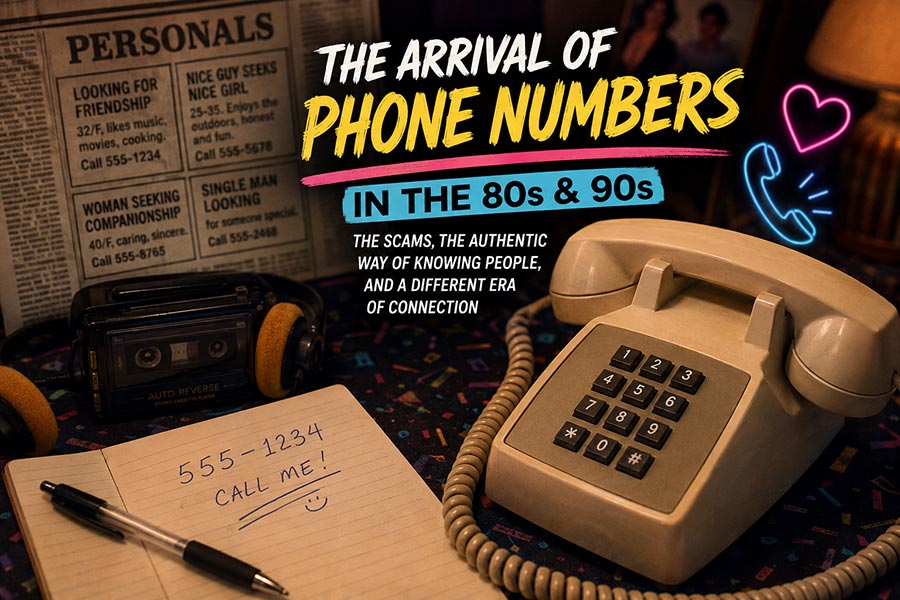
Today, giving someone your phone number barely feels like an event. We exchange numbers through messaging apps, social networks, dating platforms, and contact lists without thinking twice. In the 1980s and 1990s, however, a telephone number could represent something much more significant.
Before social media, smartphones, and online dating, the telephone was one of the few technologies that allowed people to communicate privately with someone who was not physically present. And increasingly, people discovered that a telephone number could also be a way to meet someone new.
There was something almost mysterious about it. You could hear a stranger’s voice without seeing their face. You could talk for hours without knowing exactly what they looked like, where they lived, or whether they were telling the truth. In an era before Google, Facebook, Instagram, and searchable databases, a person’s identity was often based almost entirely on what they told you.
The telephone became, in its own primitive way, a social network.
During the 1980s, telephones were already deeply integrated into everyday life, but their social possibilities were expanding.
Young people called friends from landlines. Teenagers spent hours talking from bedrooms while parents complained about the phone bill. People met through mutual friends and exchanged numbers. Singles sometimes included telephone numbers in classified advertisements.
New services also appeared that were specifically designed to connect strangers.
There were telephone chat lines, party lines, dating services, classified advertisements, and various local systems where callers could leave messages or connect with other people. Some were commercial operations, while others were informal communities.
The basic concept was remarkably similar to what people do online today: introduce yourself, look for people with similar interests, and start a conversation.
The difference was that there was no profile picture.
There were no likes.
There was no follower count.
And there was certainly no way to scroll through someone’s life before deciding whether to talk to them.
You simply dialed.
One of the most interesting aspects of telephone-based socializing was the role of imagination.
When someone called a stranger, the first thing they encountered was a voice.
That voice became the person’s identity.
Was it friendly? Nervous? Funny? Confident? Shy? Attractive? Serious?
A person’s personality had to be communicated through conversation rather than photographs and carefully constructed online profiles.
This could make conversations surprisingly authentic.
Someone couldn’t spend twenty minutes editing the perfect photograph before sending it. They couldn’t check your social media history. They couldn’t see what restaurants you visited or what vacations you took.
You had to talk.
And talking required effort.
A conversation could begin with almost nothing: “Hi, I got your number from the advertisement.” Or perhaps someone had met another person at a party and written their number on a piece of paper.
From there, anything could happen.
Sometimes the conversation lasted five minutes.
Sometimes it lasted several hours.
And occasionally, two people who had never met before discovered that they genuinely enjoyed talking to each other.
Newspapers played an important role in this culture.
Classified sections contained advertisements for practically everything, including friendship, dating, companionship, and personal relationships.
A typical advertisement might describe someone’s age, interests, personality, and what kind of person they hoped to meet. Instead of providing a website or social media handle, the advertisement would give a telephone number.
The next step was simple:
Call.
This created an interesting form of communication that existed somewhere between traditional dating and modern online dating.
The advertisement was essentially a primitive dating profile.
The telephone number was the direct message button.
And the phone call was the conversation.
There was no algorithm deciding who you should meet. There was no recommendation engine. There was no swipe.
People had to actively search.
There is an argument that these interactions could sometimes feel more genuine precisely because people knew less about each other.
Imagine meeting someone today.
Within minutes, you might know their name, occupation, relationship status, political opinions, hobbies, friends, vacations, favorite restaurants, and what they looked like five years ago.
In the 1980s, you might know only their first name.
That created a completely different dynamic.
You learned about somebody gradually.
Maybe you discovered that they loved the same music you did. Maybe they had an unusual hobby. Maybe they had a funny story about their job.
Information had to be exchanged through conversation.
There was also less opportunity to construct a carefully managed public identity.
A person’s voice, humor, reactions, and ability to maintain a conversation became much more important.
Of course, this did not necessarily make people more honest.
It simply made deception different.
The idea that scams appeared with the Internet is one of the great misconceptions about modern technology.
Scams existed long before websites and social media.
Telephone-based social services provided opportunities for dishonest people to exploit others. Someone could claim to be younger, wealthier, more attractive, or more successful than they actually were.
A person could invent an entire identity over the telephone.
And because there was no easy way to verify information, callers had to rely heavily on trust.
Some scams were relatively simple.
Someone might develop a relationship with another caller and eventually ask for money.
Others involved paid telephone services, where callers were charged unusually high rates. Premium-rate telephone numbers could turn curiosity into surprisingly expensive bills.
There were also people who used personal advertisements simply to manipulate lonely individuals.
The technology was different, but the psychology was remarkably familiar.
The scammer identified someone who wanted companionship, established trust, and eventually attempted to extract something from them.
The Internet didn’t invent catfishing.
It industrialized it.
Even when there was no obvious scam, telephone relationships carried a certain amount of risk.
Eventually, two people who had been talking on the phone might decide to meet.
That moment could be exciting—and uncomfortable.
The person on the other end of the line suddenly became a physical human being.
And sometimes reality matched expectations.
Other times it didn’t.
Someone might sound charming on the phone but be completely different in person. Someone could exaggerate their appearance, age, profession, or circumstances.
Yet this uncertainty was also part of the excitement.
People had to take a chance.
There was no extensive digital history to examine before meeting someone.
The best protection was often simply common sense: meet somewhere public, tell a friend where you were going, and don’t immediately trust a complete stranger with important personal information.
Those rules sound surprisingly modern.
Answering machines also changed telephone culture.
Suddenly, people didn’t have to answer the phone immediately.
You could call someone and leave a message.
“Hi, it’s me. Call me back.”
That simple technology introduced a new form of asynchronous communication.
People could think about what they wanted to say before calling back. They could hear someone’s voice on a recorded message. They could leave an invitation without having to deal with the awkwardness of an immediate conversation.
It was a primitive version of voicemail and messaging.
But there was something personal about it.
Hearing someone’s recorded voice could create a feeling of intimacy that a written message didn’t necessarily provide.
By the mid-to-late 1990s, the Internet began changing everything.
Chat rooms appeared.
People started using email to communicate with strangers.
Online forums connected individuals who shared specific interests.
Then came instant messaging, webcams, dating websites, and eventually social networks.
The telephone number gradually stopped being the beginning of the relationship.
Instead, it became something you exchanged later.
First came the online profile.
Then the messages.
Then perhaps a photo.
Then a conversation.
And eventually, if trust developed, the phone number.
The order had been reversed.
Modern technology has made meeting people dramatically easier.
A person can now connect with someone on the other side of the world in seconds. Dating platforms can introduce thousands of potential partners. Social networks allow people to maintain friendships across continents.
But the older telephone culture had one unusual advantage: conversation came first.
You couldn’t judge someone by their Instagram feed.
You couldn’t investigate their entire life before speaking.
You had to discover them.
That could make the process slower, more awkward, and sometimes more dangerous. But it could also make it more spontaneous.
Two strangers could simply start talking.
There was no algorithm.
There was no carefully optimized profile.
There was just a telephone number and a voice.
Looking back, the telephone culture of the 1980s and 1990s seems almost primitive compared with today’s technology. Yet the underlying human desire was exactly the same.
People wanted to meet.
They wanted friendship.
They wanted romance.
They wanted someone to talk to.
They wanted to discover people outside their immediate social circle.
The technology simply determined how they did it.
A telephone number was once a tiny piece of paper sitting beside a landline. It could belong to a friend, a future partner, a complete stranger—or someone trying to take advantage of you.
There was excitement in not knowing.
And perhaps that is the biggest difference between then and now.
Today, before speaking to someone, we can know almost everything about them.
Back then, you dialed a number, heard a voice, and started discovering the person one conversation at a time.
In that sense, the telephone was one of the earliest social networks.
It just didn’t look like one.